Search This Blog

Tuesday, September 18, 2018

Making Memories

"You know, you can buy apple cider at Walmart for about $2 a gallon," my dad said as he surveyed the piles and piles of apples waiting to be pressed.

"Yep," I responded, "But what fun would that be?"

At the same time my 13 year old was sulking in a corner because I told him he couldn't lock himself up in my bedroom to watch football. "You’re here on this extra weekend (he spends half his time with his dad and it was a scheduled dad weekend) because we are having a cider pressing party and the whole family is here. We’re doing this together. It’s going to be fun." After a minor meltdown and a little teenage drama he sat next to his grandma, grabbed a knife, and proceeded to take his anger out on the pile of apples. He checked the score periodically on his tablet and it wasn’t long before he got over his frustration and started to have fun.


We've talked about doing this for years. With a small orchard and dozens of trees in the woods we have more than enough apples to make sauce, pies, butter, and cider for a small army! Last year Pops (Mark’s dad, Ed) surprised by making us an apple press but it was a bad year for apples last year so we didn’t get a chance to use it. This year we had a bumper crop. By the time of the pressing party I already had a good supply of dehydrated and frozen apples in storage and a few dozen jars of apple sauce and butter in the cellar. The apples were piling up and I didn’t want them to go to waste. We extended an invite to friends and family and I made a big batch of pulled beef for sandwiches to feed the crew.

Mark took the Kubota out with his crew of pickers and they filled the bucket with apples from the woods - twice! Have you seen how big a tractor bucket is? We guess each bucket was 200+ lbs of apples.


This is in addition to the baskets and boxes I had filled in the previous week. Another team sat at "The Jeni Table" (we call it this because my  sister Jeni made it for me and it’s awesome) and cut apples. Another team worked in the summer kitchen running the cut apples through food processors. After grinding it up, Ed and "the boys" operated the press and from there we quick boiled the juice and bottled it up. We got the system running really smoothly just about the time we were finishing up the last batch😆


It was a little chaotic and a big mess. There was a little blood and more laughing than cursing. All in all, I t was a perfect family gathering and, I hope, the beginning of a new tradition. 20 years from now my boy won’t remember a football game he watched on TV but I’d bet a bucket of apples he’ll remember the days we spend pressing cider at the farm.


Saturday, May 12, 2018

Why Buy Your Meat Directly from a Farm?

Do you buy grass fed meat? I keep hearing about Butcher Box and I love the idea that people can get better quality meats at a better price. We get questions all the time about why we charge "so much" for our beef. In truth you can buy beef shares for $2.50 lb for conventional or mixed feed (combination of grass & grain). I was starting to wonder if our prices were too high so I looked into it.  I chose Butcher Box because it was the most comparable quality I could find.  Their basic package is $129 for 8-11 lbs of meat meaning your cost ranges from $16.13 - $11.70 lb. This is a great deal compared to grocery store or co-op prices for similar quality. I can see why my health conscious and eco-minded friends are excited about it. 

But how does it compare it to buying directly from a farm like ours? 

We sell our beef shares at $4.50 lb hanging weight (this is the weight after skull, hide, guts, and hooves have been removed) plus processing. Processing fees will vary depending on which cuts you choose.  It includes $100 per whole animal for onsite slaughter and butcher cutting fees. A butcher we frequently use charges $0.58 lb. Processed items such as ground beef, sausage, smoking, etc costs a little more at $0.75 lb. Combined, your cost will vary but we have seen an average of $6 - $6.50 lb. This includes filet mignon, t-bones, rib eye steaks or rib roasts, cuts that sell for over $20 lb for grass fed and organic!

Farms like ours are where the co-ops, grocery stores, and delivery services buy their meat, sort of. We also use no hormones, no chemicals, and no antibiotics. Ours is also grass-fed and grass-finished. Our animals are also humanely raised, but here is where we find the important difference. Most humanely raised animals end their lives by being loaded onto trailers and being hauled to a processing facility. Even when methods are implemented to make the process as stress-free as possible for the animal - it is what it is. There will always be some level of stress to the animal when it is done this way and, if the meat is to be sold as packages and cuts, it is the only legal option. This affects the quality and flavor of the meat as well as the subtle energy. This is why you won’t see packages of steaks or ground beef from our farm at your local co-op. This part is so very important to us. Our animals are humanely harvested - on site at our farm. They are never loaded onto a trailer or taken away from their home while they are alive. They are born here and they die here and we do everything we can to make that happen swiftly and painlessly - no stress hormones, no fear. 

I once had a teacher challenge any advocate of "humanely raised" meat to watch the slaughter and still argue that it is humane. I can honestly say that I have and I can. 

Tuesday, April 3, 2018

AIP Keto Toasted Coconut Turmeric Fat Bombs

The more I learn about Keto and AIP diets the more I understand that I personally need to combine them to get the best results. With multiple food allergies and Hashimoto's Thyroiditis, the keto recipes that are within my realm of safe foods are pretty limited, so I've been experimenting with recipes that fit into both AIP and Keto and I've been having good success. My current obsession is anything called a Fat Bomb! If you had told me even a year ago that I would be making delicious food loaded with healthy fats and calling it health food I would never have believed you. But here I am today making all types of fat bombs: chocolate, turmeric, sweet, savory... yummy!

One of my daily staples in this way of eating is Laird Superfood Creamers. I use them in my morning coffee, to flavor shakes, and now in my fat bomb recipes. Get your Laird Superfood Creamers and all of the other ingredients to make this recipe at Thrive Market (and get 25% off your first order and free shipping for orders over $49).

Ingredients:
1 cup Thrive Market Organic Coconut Chips
1/2 cup  Nutiva Coconut Manna
1/4 cup Nutiva Virgin Coconut Oil
2 tbsp Laird Turmeric Superfood Creamer
1/4 tsp Ground Cinnamon
1/8 tsp Ground Black Pepper
a pinch of himalayan pink sea salt (or any sea salt)

Preheat oven to 325 and line a baking sheet with parchment paper. Spread the coconut chips and bake 5 minutes. Stir and bake another 3-5 minutes until evenly toasted.

Add the remaining ingredients and mix well. *if the coconut butter and oil are firm you can soften them up and make them easier to work with by gently heating - in a saucepan, a bowl of water, or microwave on low setting for 10 seconds at a time

Line a mini muffin pan with paper muffin cups and divide equally between 8 cups - you can also use an ice cube tray but it can sometimes be difficult to get them out of the tray.

Chill in the fridge or freezer until solid. Store them in the fridge or freezer - they will melt at room temp.

Tuesday, March 6, 2018

AIP Keto Pumpkin Bars

Recently, my doc suggested I go gluten free. Add this to my list of food allergies and the list of foods I can eat is starting to look pretty sparse. Luckily the Autoimmune Protocol eliminates all of the the things I am trying to avoid so I just need to search AIP recipes for ideas. If you know me at all you know I rarely follow a recipe. What fun would that be? I tried this one last night. It's a modified version of a few others I found on-line. The others had ingredients I didn't have on-hand so I improvised. I put them in the fridge just before bed so they could chill overnight and had one for breakfast. I'll be honest, I didn't have high hopes. They smelled pretty good when they were in the oven but they really didn't look good at all and the texture of the batter as I was spooning it into the pan was not appealing. The final taste and texture was a pleasant surprise! They are super easy and pretty darn delicious. Maybe I'll have another...

AIP Keto Pumpkin Bars

INGREDIENTS (makes 8 bars)


  •  1/2 cup coconut oil
  •  1/2 cup Sunflower Butter
  •  1/4 cup Coconut Flour
  •  1 1/2 cups pumpkin puree
  •  2 tsp cinnamon
  •  1 tbsp Monkfruit Sweetener, Classic (or other keto sweetener)

DIRECTIONS

1On the stove, melt coconut oil and sunflower butter over low - medium heat.


2In food processor, add squash, spices, coconut flour, salt and monk fruit. Pour melted coconut oil and sunflower butter on top and blend for 30 seconds being sure all the big pieces of squash are blended.


3Spoon into a small glass or ceramic baking dish (I used a 6x8 Pyrex).  and use a spatula to smooth it out. Bake for 25 min at 350 degrees. Remove from oven, let cool, then cover and put in fridge until completely chilled.


NUTRITION INFORMATION (according to www.livestrong.com/myplate)

261 CALORIES PER SERVING

Serving Size: 1 bars

77 %16 %7 %
 22g Fat
 10g Carbs
 5g Protein
% DV*
Total Fat  22g33%
Saturated Fat  13g
Cholesterol  0mg0%
Sodium  174mg7%
Carbohydrates  10g5%
Dietary Fiber  5g
Sugars  3g
Protein  5g3%


Read more: https://www.livestrong.com/recipes/yoga-valley-aip-pumpkin-bars/#ixzz5906GgZC8


Wednesday, February 7, 2018

5 No-Nighshade / AIP Game-Changers

It's been a while since I've written anything related to no-nightshade but with the Autoimmune Protocol Diet becoming more prevalent I've noticed that suddenly we have a lot more resources to work with.  Ingredients labels are more specific when listing individual spices, Pinterest is full of no nightshade recipes (Autoimmune protocol is like Paleo with the additional elimination of nightshade, nuts, and eggs). Grocery stores are carrying a wider variety of allergy friendly foods and on-line markets are catering to specialty diets.  This is a list of the things that have rocked my world in the last few months by making cooking & eating nightshade-free safe, easy, and inexpensive.


  1. Instant Pot:  I had been hearing the buzz about Instant Pots for a while but I figured it was just another kitchen gadget that will, after a few months, end up collecting dust in the pantry. I got an Instant Pot for Christmas and already this thing is my go-to for just about everything.  It now lives on the counter-top where the crock pot used to live. The crock pot is now collecting dust in the basement.  I'm just starting to explore the possibilities but already I've made bone broth multiple times; roasted beef, pork, and a whole chicken, and cooked dried beans both soaked and unsoaked. From what I've read this is just scratching the surface of what this thing can do.  It's a rice cooker, bread baker, & yogurt maker. It can cook fast or slow, steam, saute, and pressure cook. About the only thing it doesn't do is grill. I can live with that.
  2. Thrive Market: There are SO MANY online grocery options to choose from. Thrive Market is the one I stuck with. I use it for my specialty items - the things that are hard to find and usually cost more at the co-op or grocery store or the staples that I'm willing to pay a higher price for to have the best quality. You can't get anything fresh or needing refrigeration. I buy my cooking oils, bath products, home cleaners, Epic paleo snack bars, and Laird Superfood Creamers, and occasionally try or buy other things when they are on sale. The prices are legitimately lower than grocery store prices and just about every day there is a sale or freebie. I wait for a sale or freebie on something I want and stock up for additional savings. Your first order is 25% off if you click here and shipping is free for orders over $49. After the 30 day free trial, there is an annual fee of $59, which I more than made up for on my first order. In full disclosure: I will receive a $25 credit if you activate the annual membership but I would recommend it even if I didn't. You can earn credit too, if you love it and tell your friends about it and they sign up using your link! 
  3. Laird Superfood Creamers:  Most days I am out the door by 6 a.m. I fill up my coffee cup with my coffee and coconut milk creamer and hit the road. By the time I get to town an hour later I'm definitely ready for another cup but no-one serves Bullet Proof coffee in my town. The closest you'll get is coconut milk (the super processed milk replacement) which really just waters down the coffee. A few months ago Thrive Market had a great sale on Laird Superfood Creamers so, after reading the ingredients and a little bit about the product, I gave it a try. I ordered the regular, cacao, and turmeric. YUM! It is delicious, healthy, and ethically sourced. It's in a powder form and doesn't need refrigeration so I keep a bag in my purse. I use the cacao or turmeric flavor mixed with coconut milk for a night-time treat and the regular for my coffee. Next time I order I'm going to try the instant coffee with creamer. It's less expensive than buying my dark roast at the coffee shop. I'm always looking for ways to save a few bucks.  
  4. Epic Bison Bacon Cranberry Bars:  If you know me you know I always carry a little lunchbox with me, full of snacks.  On work days I'm out of the house for 12 - 16 hours. If I'm not prepared I end up spending too much $ on too little nutrition at the most convenient restaurant, market, or gas station.  Most paleo snack bars and jerky contain either nuts or spices that I can't have. Epic Bison Bacon Cranberry Bars have no nightshade spices and are pretty darn tasty. I've also noticed that my hair which, because of a thyroid disorder is normally dry, brittle, and thin, always looks and feels shinier and healthier when I am eating these bars on a regular basis. Bonus!
  5. I'm going to start this one with a disclaimer: I am not a fan of MLMs (Multi-Level Marketing). I avoided Isagenix for years despite seeing the results my friends got strictly because it is a MLM.  After frustration at steady weight gain and declining health I finally reached out to a friend, who I trusted would not be pushy or try to sell me anything I didn't want or need and gave it a try.  I had been using meal replacement shakes as a convenience meal for years anyway so why not try a different brand?  The problems with meal replacement shakes for me have always been the same, regardless of the brand:
    • They don't taste very good so you end up adding fruit, sunflower butter, and other ingredients to make them taste better which end up adding to the calorie count.
    • They fill you up for about an hour. Then you are hungry again and end up eating so you are in essence, adding to your daily calories rather than reducing them.
    • They are expensive.
Simply put, I found the Isagenix shakes to be tasty, satisfying, and (if you are on auto-ship) a little less expensive than the other brands I was using. I can have one as a meal and it will sustain me to the next meal, even with my activity level. If you are strict about sugar you should know that there is sugar in them. Maybe that's why they taste better than the others.  There are a few flavors that are safe but you do need to read the ingredients. Berry flavors are off-limits for sure. My favorite is the dairy free chai. Cookies and cream was pretty good too but it's not always available. The chocolate is a little too chocolatey for me but I mixed it with both chai and cookies and cream and that worked pretty well.  As I said, I'm not a fan of the whole MLM thing but I like the product. If you want to give it a try I'll help you sign up or you probably already have a friend who is doing it. Reach out to them. I'm feeling good again. My energy levels are stable, the mental fog has lifted, and I'm steadily dropping pounds without starving myself.


Monday, January 22, 2018

Flying

I remember the first time we let her off her leash. She was 7 months old and had come from a shelter in the city. They had no background information on her so we had no idea how she would behave off-leash but there was only one way to find out. We spent lots of time with her in the house off-leash and outdoors on-leash to see how she behaved. Her attention stayed on us as if asking us what we wanted her to do. She definitely wasn't a wanderer, explorer, or independent spirit and she wasn't skittish or jumpy. She stuck to us like glue so we decided it was safe to try it out.

We brought her out to the middle of the pasture, far from the road and other distractions.  It took her a few seconds to realize she didn't have a leash on and that it was actually OK to run. After a little bit of encouragement she started to run in big looping circles, sort of slow at first, then testing her speed. "I bet she's never run like this before," Mark said, and he was probably right. Even if she had been in a home prior to the shelter what are the chances she had ever had the opportunity to run all-out, completely free? "It must feel like flying to her, to run like that," he said and you could see in her face that he was right.

Monday, December 11, 2017

What Do Farmers Do When They're Sick? The Same Things They Always Do, Just Slower.

This morning I was curled up on the couch with my computer, a can of Coca Cola, and a sleeve of saltine crackers (time-tested family remedies for a sick stomach). Mark had gone out to do a few chores - run hay to the ladies and to fill water tanks. Right around the time I was starting to wonder what was taking him so long I heard him come through the front door. "Babe, can you put on your warm clothes and come out?"

Oh sh-t.

He witnessed my stomach convulsions this morning and would not be asking if it wasn't serious.

"What happened?" I asked as I got up and headed for my Carharts.

"We've got an emergency."

Crap.

An emergency here can mean any number of things. It might mean the hydrant is frozen or that the tractor won't start but he wouldn't be asking for my help today if it was something like that. I went outside to see the Kubota at the bottom of an icy slope, a bale of hay laying down a section of barbed wire fence, a broken wooden fence post, and a crowd of hungry cows trying to get to it.  My first thought was thank goodness he didn't roll the tractor. My second thought was how long before the cows realize that fence is down and they are scattered all over the property?  What now?  Being far from mechanically inclined, my job in situations like these is usually to run and get what he needs and to generally be an extra set of eyes or hands.

For the next 2 hours we worked on getting the Mahindra started (of course today of all days it doesn't want to run) so we could pull the bale off the fence and move the Kubota. He got the Mahindra limping along and dragged the bale with a strap into the pasture where it stalled again. We walked back and forth over lumpy, frozen ground that you can't possibly imagine unless you've been in a frozen pasture before, and with every step I'm whispering under my breath, "Please don't hurt your knee." The last thing we need right now is Mark to be injured and his knee has been giving him a little trouble lately. The cows were in the way the entire time. Did you know I'm afraid of the cows? I can hang out with some of them, feed them treats across the fence, and snuggle up to the sweet ones but I panic at the thought of walking within 10 feet of the bull or the general population crowded around a bale, not to mention trying to jump starting a tractor surrounded by cows frantically trying to get to hay, pushing each other out of the way, and slipping and sliding on the frozen earth as much as we were.

We got it fixed, hauling tools out and fixing it in the middle of the cow yard. We got the bale moved and both tractors out. The cows are fed and the fence is still mostly intact, stretched but intact. That repair will have to wait for spring. The other day I posted on Facebook the statement, "What do farmers do when they are sick? The same things they do every other day, just slower." I wasn't trying to get sympathy or complain, I was just making a comment on reality. This is the reality of being a farmer. Some days you are getting a wet kiss from a calf and others you are trying not to puke as you work because the work has to be done. It's not even that there are good days and bad days. There a days. They are all days. Any day we are here is a good day.


Thursday, February 16, 2017

Tracy's Got a Gun

I was so excited about the gift my boyfriend got me for Valentine’s Day, a .22 rifle, so like most people do when they are excited about something, I posted it on Facebook.  “Nothing says ‘I love you’ quite like a Mossberg 715 Tactical .22 Long Rifle”.  Most of my friends got it.  They understood what that meant to me and why I would be excited to share it.  A few did not.  One commented, “No thanks”.  Excellent!  I hope your husband got you something you love, whatever that might be.  I love my gift.  Another asked, “Why?”  Knowing this person to be a thoughtful individual who might actually be seeking to understand something from another person’s perspective I decided to explain the “why”.  I’m guessing she’s not the only one asking this question.

Mossberg .30-.30 lever action.
To my friends who don’t have and don’t want guns - I get it.  I respect your choice and understand the many reasons to not own a gun.  For many reasons, that was also my choice until the last few years.  I lived in a quiet suburb with very low crime rates.  The chances of encountering a fox, coyote, or other animal that would threaten my safety, that of my child or my dog on our daily walks was slim to none.  But, if I am being completely honest, I was afraid, and my fear came from a lack of experience and knowledge.  I did not grow up with guns, my family didn’t hunt, and it just wasn’t part of my upbringing.  My parents didn’t teach me to hate or to fear guns, they were just something I didn’t understand. No one I knew had them, or if they did, they did not talk about them.  From my limited view, only cops and criminals had guns.

A few years ago I moved to a farm to live with my boyfriend.  I learned very quickly that the thinking about guns is very different here.  Out here, just an hour from my former suburban home, just about everyone has guns the same way just about everyone has a tractor - another thing I didn’t understand or need in the past.  What I want my city friends to understand is that for some people, guns fall into the same category as tractors.  They are useful tools.  Yes, we sometimes collect interesting guns the way some farmers collect old tractors and target shooting can be enjoyable but guns have a legitimate place in homes here.  We have different guns for different purposes.  We take care of and value them.  We teach our children to use them appropriately and safely.  We also take them seriously.  We have locked safes and there are no toy guns or video games with guns allowed in our home.


The first gun Mark bought for me was a Mossberg 464 SX Tactical .30-.30 lever action.  I spotted it at a gun show because I liked the way it looked - like something out of the Sci-Fi series Firefly, cowboys vs. aliens.  That was what got my attention but the reason he bought it was because it was a good hunting gun for me.  I have an old shoulder injury that affects the way I hold a rifle and it means I need a very short stock.  Most tactical guns have adjustable stocks which I can adjust to shorter even than that of a youth gun.  I practiced shooting targets so that if I did take a shot hunting, I would be able to make a clean kill.  We hunt to help control the deer populations which would easily grow out of control without human intervention, and use the meat.  I haven’t yet had a shot worth taking.  However, I was extremely grateful for the gun knowledge when I found a dying calf in the pasture and was able to end it’s life quickly and painlessly rather than watching it suffer.  I also appreciate the feeling of safely it brings me to know that I do have protection if I do encounter a bear, wolf, or coyote while out picking apples in the woods, should it choose to do something other than walk away.  It would not be an altogether unusual thing to happen in this area.  Another point of brutal honesty; every once in a while you meet someone who makes chills run up your spine.  I have met a few of these people.  Home alone, where the neighbors are too far to hear even your loudest cries for help and your cell phone doesn’t work, I am not ashamed to admit that I feel more confident knowing there is a pistol in my waistband as I do the evening chores. 

Over the last 3+ years I’ve acquired a few more guns of my own; a better hunting rifle, a shotgun, a pistol to carry, a revolver, and a Deringer that fit into my collection of “unusual, Wild Wild West, steampunk, cowboys vs. aliens firearms”.  I took a Conceal & Carry class, not sure at the time if I wanted to carry or not, but figured it would be useful information either way.  I’ve also had the opportunity to shoot guns owned by my boyfriend and other friends.  I’ve learned that shooting is a sport that requires extreme mindfulness and presence.  Mark has said since we first started talking about teaching me to shoot, “I think you’ll be good at this.  You know how to breathe.”  For my yogi friends, if you let go of the judgement that guns are “bad” and see them as inert pieces of equipment that only do what you make them do, they can appeal to all of the skills we seek to hone as yogis.  Imagine I was throwing a javelin instead of shooting a gun, or practicing sword fighting.  Would it bother you the same way that my shooting a gun does?  A javelin and a sword are instruments of death, used for hunting and war.  It requires skill and focus to achieve the target.  In the hands of someone untrained or with ill intent, they become frighteningly deadly weapons, but in the hands of someone trained and dedicated, can be an amazing show of skill.  As a yogi and a shooter, I can tell you that target shooting; checking your firearm and loading it safely, lining up your sights, steadying your breath, your hands, and your mind, and finding exactly the right moment to pull the trigger are some of the most mindful experiences I have ever had.  


Mark gave me my first pistols as a birthday gift, the Derringer as a surprise just because he saw it and knew I would love it, and the Mossberg .22 for Valentine’s Day.  First, a quick note about this last gun, the one that spurred this explanation. 

It looks pretty intimidating, doesn’t it?  It’s not.  A .22 is what would be used for shooting rats that get into the grain and foxes threatening the chickens.  This gun is the same caliber as a gun called the “Cricket”, a kids gun designed to be used by children to teach them firearm safety and handling.  The AR style is just that, a style.  I like it because it is an adaptive piece of equipment,  It has an adjustable stock which means I can comfortably fit it to my bad shoulder and it has ghost ring sights which work better for me than a regular scope because of my left-eye dominance.  These are some of the reasons why it was a great gift for me.  My love knows how difficult it is for me to find a rifle that I can hold properly and comfortably.  He knew I would like both the style and the fit of the gun.  He knew it would be an easy gun for me, still an inexperienced shooter, to use and to learn with.  This was a gesture of caring and trust.  He picked out the perfect gun for me the way a different guy might pick out the perfect pair of earrings for a different girl, but I don’t have pierced ears!  I know it might be hard for some of you to understand that I truly don’t want flowers or a candle lit dinner for Valentine’s Day.  Shooting is one of the things that my love and I share.  It is time spent together. We go to gun shows and auctions together and look for unusual finds and collectibles.  We watch old Westerns and talk about the different guns they used.  To him, guns have always been a part of life.  To me, they are new and interesting.  For him to share this part of his life, his experience and knowledge, and for me to realize that my prior judgement about what guns and gun owners are, and that it was not a complete picture and was founded on fear, these are truly great gifts to me. 

Tuesday, October 25, 2016

Full Circle

It was my first calving season at the farm and I was so excited to experience this part of farm life.  Mark and I stood outside of the cattle shed, talking about what - I don't remember.  We had come out this April morning to check on the ladies and had found nothing happening.  As we stood there chatting something caught my eye.  In the mud and muck, wedged under the fence, I saw the movement of a pig-ish nose.  My mind scrambled to figure out how we could possible have a pig in the cattle shed!  Which of our neighbors raises pigs?

"Mark, what is tha...?
Is that a...?
Oh my Go...!
It's a calf!"

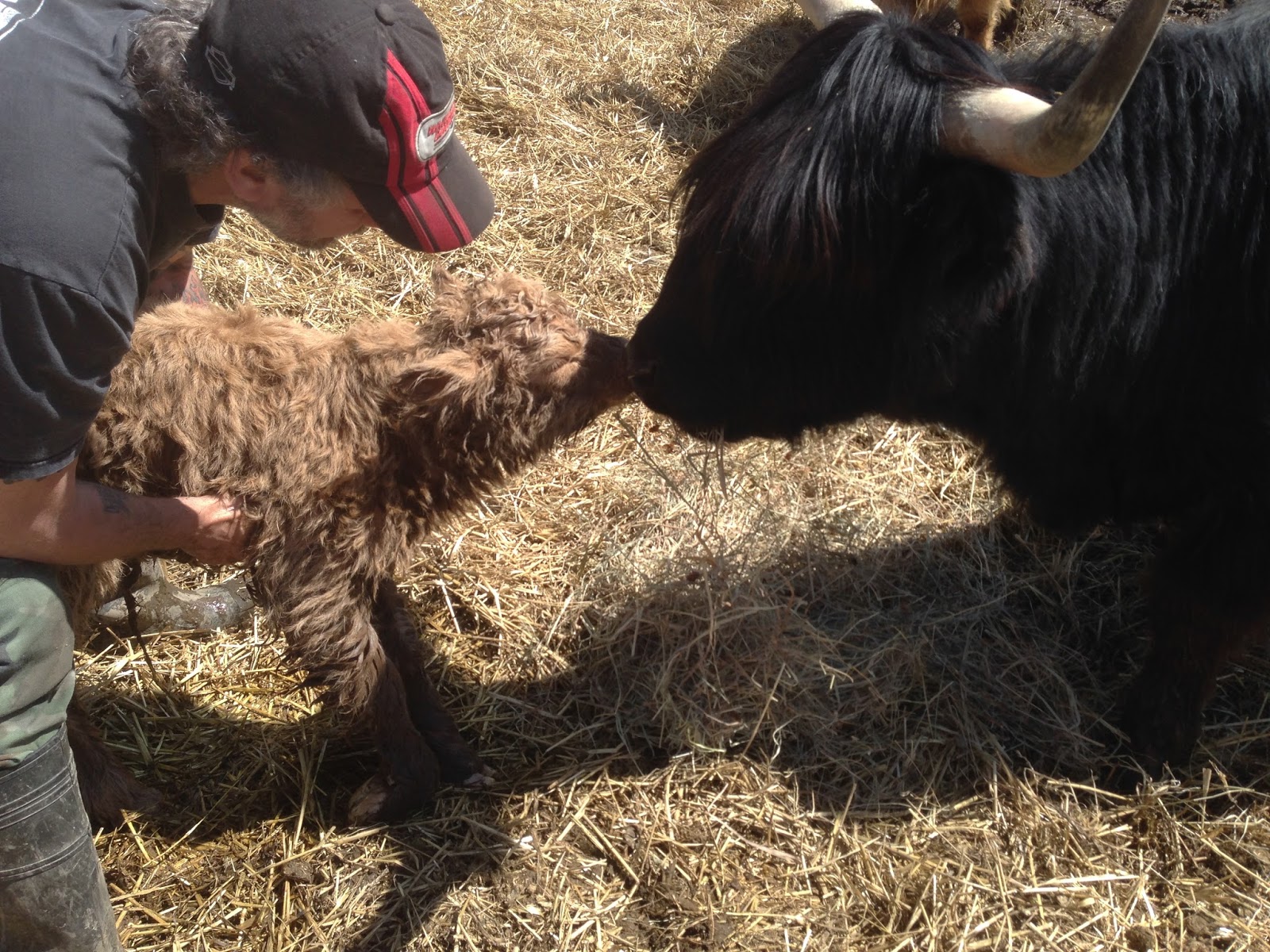
Walking closer to get a better look, I realized that this pig-sized and pig-nosed animal, completely submerged in the mud and muck of the cattle shed and wedged under the gate was not an escaped pig but, in fact, a newborn calf.  Mark rushed in and carried the calf to drier ground.  I ran for towels and buckets of warm water.  Mama was nowhere to be seen. After cleaning up the calf the rest of the herd became curious and every one came to sniff and check it out.  We determined that mama was Maudine.  This was her first calf and she didn't seem to have any interest in tending to him.  Covered in mud and manure, its nostrils packed with the same, perhaps the scents that would normally trigger the mother/calf instincts were still dormant.

We spent frustrating hours trying to bring mama closer to her calf in the hope they would recognize each other.  By the afternoon, baby still hadn't fed and we were wondering if we would be hand-raising this one.  Daily care and bottle feedings sound like a sweet and wonderful thing to do but the reality is that it is a major commitment of time and resources and many farmers would choose to cull the calf rather than take this on.  For us, with full time jobs off-farm, this would have been an exceptional challenge.  Luckily, this wasn't a choice we had to make.  Once we had Maudine and the calf separated from the herd in an isolated portion of the barn, the calf finally attached and we breathed a sigh of relief.  Actually, after hours of worry, I'm sure I sobbed my relief more than sighed.


The calf grew well and we named her Lola.  All of the year's females would have L names but Lola ended up being our only girl, the only calf from the season who would be sold as a breeder rather than raised - unnamed - for beef.  One day, standing in the pasture watching the herd, one of us (I don't remember who) noticed that there was something very wrong with Lola.

Lola had balls!

By this time Lola was Lola and he kept his name.  Lola was one of the "Naughty Boys".  Every year there are a few who have no respect for fences.  They get out and wander the property, sometimes wander down the road, at times even visiting the neighbors.  For as much trouble as they cause - walking through my gardens and causing strangers to stop in at all times of the day and night to let us know "your cows are out" - these naughty ones become our favorites.  The naughty ones are the ones we interact with daily.  They curiously check out the bonfire, drink from the bird bath, and munch the long grasses that border the yard as we go about business as usual.  Generally more socialized and friendly than the rest of the herd, they are especially calm and easy to work with.  They trust us and we trust them.   It doesn't take long for them to learn the routine and when we tell them it's time to go back inside the fence they amble down the driveway and through the gate easily. At times, we just let them stay out and wander as long as they are safe on our property and not close to the road.  Some of my best photos are of these naughty ones because there is open landscape in the backround, no fences.

I always try to be there when the butcher comes.  As difficult as it is, it is important for me to be there, even more so this time.  If you are cringing and withdrawing at this point, be assured.  Our butcher is quick.  The animals are not frightened or in pain.  One instant they are grazing peacefully in their home pasture,  the next they are gone.  I have watched before.  It is always difficult.  But it's important.  Lola's life, like the lives of all pasture raised livestock, was  important.  He fed in the pastures, encouraging deep rooting of the pasture grasses, which anchor the topsoil and decompose to provide nutrients to the soil.  His hooves tilled the earth with each step.  As he walked he fertilized the land.  With his death this one cow will provide enough beef for a full year for our family and friends.

This is the point where I want to go off on a pre-emptive rant about the impact of vegetarianism on the environment but that's not what this is about.  We all have the right to believe as we will and we can all find plenty of Google-searched charts and studies to back us up.  Instead, I will allow myself to feel the sadness of their deaths of Lola and the other two steers.  I will recognize the importance of their part in a much bigger picture and I will give thanks and gratitude for their lives.


Thursday, January 14, 2016

Slow and Low: How to Cook Grass Fed Scottish Highland Beef

I remember the first time I grilled steaks from our cows.  They were horrible.  Really, truly horrible.  I cooked them just the way I always did my grass fed steaks, on medium high heat for just a few minutes on each side, enough to sear the outside and leave the inside perfectly medium rare.  Overcooking a good steak makes it tough, right?  So I couldn't understand why these steaks were so tough!  Someone suggested that grass fed meat is just going to be tough and I could marinade it in Coca Cola or Sprite to help break down the fibers.  It seems this is a common practice to which I say, "UGH!  Why bother with good quality meat in the first place?" I could also make my roasts in the crock pot in a plastic roasting bag for easy cleaning (along with BPA , phthalates, and other plasticizers) with a packet of meat marinade (aka chemical shit storm).


Hmmmm.....

No.

But, after gnawing away unsuccessfully for a few minutes I decided to throw them back on the grill for a while and after cooking the steaks to what I would have previously considered incredibly over- done, they were not great, but at least edible.  The flavor was good and they were tender.

Since that time I have had quite a bit of practice and what I have discovered is that the meat from our cows is quite different from even the best quality grass fed beef I used to purchase at the co-op.  It is denser, richer, and not as lean as what you would typically expect from grass-fed  Most cooking sites will tell you that grass fed beef is leaner than conventional beef but this is a generalization.  The amount of fat and the overall texture of the muscle will vary greatly from herd to herd, not only because of different food sources but also because of variance in breed, climate,  and lifestyle of the animals.  I guess our Scottish Highland cows have a pretty laid back life because their meat has some really nice marbling.  The quality and flavor of the fat is different as well.  Even though there is a nice amount of flavorful fat in our cuts, the fat does not render the same as beef from other sources I have used.

To get the most flavor and tenderness out of our Scottish Highland beef I have had to disregard everything I used to know about cooking beef.  Slow and low is the way to go and I cook my steaks to more "doneness" than I used to.  To get a really tender and tasty steak you really need to cook it slowly to medium well.  Otherwise it's going to be tough and fatty.  I know, I resisted too.  Everyone I know who likes their steaks rare or medium rare has trouble with this point but you just have to trust me on this one.
Cast Iron on top of the wood burning stove - yum!

Here are my tips for a perfect steak or roast:

1)  Thaw at room temp before you put it on the heat.  After you have completely defrosted the meat overnight (or longer) in the refrigerator, set it out on the counter for 20 minutes to an hour.  The amount of time you leave it out will depend on the size of your cut.  You will need more time for a 5 lb. roast to come to room temp than a 1 inch steak.

2) Cast iron is best. Stainless steel is an acceptable second choice.  Teflon coated or other non-stick pans?... Nope!

3) Bones add flavor.  When I was pinching pennies I always bought boneless cuts.  Who wants to pay for the weight of a bone?  But a cut of meat with the bone attached will have more flavor than one without.  When you can,  cook meat on the bone.  I save the bones, throw them in a crock pot with water, some cider vinegar , onions, carrots, celery, and a few seasonings and let it cook for at least a day - sometimes up to 3 days. Strain this into jars or just pick out the bones and you have made your own amazing and nutritious bone broth.

2) Always sear.  For steaks, start with a med/high heat and just a few minutes on each side before reducing the heat.  I like to put a layer of salt & pepper on the meat before searing but you could make up a seasoning rub with just about any dried spices or herbs that you like.  For a roast, sear all sides before putting it in the roaster or crock pot, especially on the side with that nice layer of fat.  Let it start to render.  Add a little broth, wine or water to your pan to help scrape up the brown bits and pour that into the roaster.

3) I have had great luck with my steaks in the broiler.  I like them even better than on the grill.  I use a cast iron pan and sear one side on the stove top.  Then I flip the steak and put the pan under the broiler.  My broiler doesn't have a low setting but I can reduce the heat by putting it on the lowest rack, far away from the heating element.  If you like it a little crustier you can always move it higher for the last few minutes of cooking time.

4)  Cooking time varies by cut, thickness, starting meat temp, and other factors.  Don't rely on a set amount of time.  Never walk away from a steak.  Pay attention, check in, and test for doneness by pressing on the steak.  It's firmness will tell you how tender it is.  This might take a little practice to learn how it feels when it's just right for you but, again, too many variables for a one size fits all description.  Please,  I beg you, do not check for doneness by cutting into the steak.  Much of the juices will drain out and your steak will not be as good as it could have been.

5)  Cook slow & low.  This gives the fats time to break down and distribute their flavor into the meat. A higher heat can cause the fibers of the meat to contract, making it tough.

5) Let it rest.  Give the meat a good 10-20 minutes, again this depends on the size of the cut you are working with.  During this time the rendered fats and juices will be distributing and cooling in the fibers of the meat where they will impart their juiciness and delicious flavor.  Don't worry, did you know that new science shows that fat from healthy, grass fed animal sources is good for you?  It is! And it's delicious.  So enjoy!

*Note:  If you are following a favorite beef recipe you might try just dialing back the cooking temp and upping the cooking time a bit.  This has worked for me with recipes from cookbooks and other blogs.  For my first Prime Rib I used a recipe from the Complete America's Test Kitchen cookbook which is, by the way, the absolute best cookbook ever.  Everything I've made from it has been the bomb.  It turned out fantastic but I did cook it on 250 for almost 5 hours.


This handsome fella is D3.  

Tuesday, December 29, 2015

One Word

We start the new year with such good intentions. Whether it is a resolution or an intention, tradition says that the first day of the year is a good time to change something in your life.  According to online statistics, as few as 8% of people consider themselves successful in their resolutions by the end of the year.  This is obvious when you compare attendance at gyms & fitness centers from January to March. 

I remember the time I resolved to quit smoking. I think I made it until 12:01 AM.  Eventually, I did successfully quit but, like most life changes, it took time and a few failed attempts. This was also the year that I quit resolutions.  Why set myself up for failure, knowing that for me, change takes time? 

Many years ago, sitting at a table with a group of friends, I had an "Aha Moment". It was one of those moments where you see yourself in a situation clearly, as others do, and you cringe.  I reflected on that moment for days and after a time I 
accepted that this habit, or personality trait I had that I wanted to change was deeply embedded. It wasn't going to be easy.  I thought about it more and asked myself what could I use as a reminder when I found myself in certain situations and I chose one word.

For a long time (years!) I would remember my word too late, after the fact, but I remembered. I kept bringing that word into my mind. I started to recognize situations sooner and to bring in that one word sooner. I chose that word over 15 years ago and I still use it at times.  

Last year I realized that it was time for a new word.  I had become aware of my reactions & responses to other situations that I did not think were useful or in my best interest.  Again, I boiled it down to one word, one word that reminded me to step out of my habits, my insecurities, my conditioning, and see clearly.  I will carry this word for as long as it serves me and when I'm ready I will add another.  Each of the words clears away more of the dust that has settled in my mind and on my heart over the years and honestly, makes my life brighter, sweeter, and infinitely easier.

Trust
Listen
Love
Peace
Rest
Strong
Truth
Soft
Release


Tuesday, October 6, 2015

Give Your Furnace the Cold Shoulder

It’s October and temperatures have dropped quickly here in Wisconsin.  In just a few days we went from overnight lows in the 60’s to lows in the 40’s.  The cattle are frisking about the pasture, absolutely joyful to have a break from the summer heat and humidity.  The pigs cannot get enough to eat as their instincts are telling them it’s time to start packing on the fat (they don’t know that Mike the Butcher is coming tomorrow).  Many of my friends are posting on Facebook that they have given in and have turned on their furnaces or that they are thinking about it. Even though I am the personification of the term “Freeze Baby” and there are few things I love as much as a fire in the wood stove, I am not ready to give in just yet.  

Not much comes easily here and we don’t take much for granted.  The other day, we were talking about firewood with some friends, fellow farmers.  Someone said, “It’s not like it grows on trees.”  Well, literally speaking, yes it does but it takes time and energy to cut, haul, and stack.  Or you shell out the hard earned dough to pay someone else to do it.  So, even though I am the first one to complain about being cold, I will be one of the last to light a fire in the wood stove or turn on the heat.  No, I won’t be walking around my house bundled up in outerwear.  Socks and a sweatshirt?  Sure, but no abominable snowman attire needed.  Here are the little things we do the keep the cold at bay for a few more weeks and keep fuel usage in the coldest days of winter.

Take advantage of the daytime sun. 
Open curtains and blinds on East facing windows in the morning and on West facing windows at night.  Close the blinds when the sun isn’t shining directly in.  I am constantly amazed at how much heat the house picks up from the sun, even on really cold days, when we do this.

Close doors. 
My son lives with me for a week, then with his dad for a week.  When he is not here, his bedroom door is closed.  We also have a small room at the front of the house we call the “summer kitchen”.  It has large windows and protrudes from the living space so that it is less sheltered by rest of the house.  The door separating this room from the rest of the house is closed at night and open it in the morning while the sun is shining in, allowing the warmth that gathers in that room to flow through the house.  At the top or bottom of staircases many homes have doors.  We have a heavy curtain at the top of the steps.  I open or close the curtain to regulate the temp between the upper and lower levels as needed. 

Get in the kitchen.
In the summertime I do not cook pot-roast. I buy my bread and cookies and other baked goods from the Amish bakery down the road or the Co-op.  Now that the weather has cooled it’s time bring the roasting pans, cookie sheets and crock-pot up from storage in the basement.  During the early fall when days that are warm and nights are cool, I bake cookies, cakes, crisps, bread, and other baked items in the evenings.  Crock-pot oatmeal adds a little overnight heat and takes the chill off the morning air.  Later in the season I will add crock-pot meals on weekdays when I am not home to come home to a ready meal and a warm house.  On work from home and weekend days I will simmer soups and sauces, make stock from the bones I freeze all year long, and slow cook roasts, whole chickens, and ribs.  I will pull the produce that I froze earlier in the fall from the freezer for canning, adding both heat and moisture to the dry, cold winter air.


Some of these things may seem simple, “no-brainers” for many of you.  But I never thought of these things when I lived in an apartment in the city.  I didn’t need to.  I just turned on the heat when I got cold.  Opening and closing doors and curtains is about as simple as it gets.  If you are going to cook anyway why not make the most of it? Maybe you’re not a baker or don’t love to cook.  Crock-pots are excellent tools for those who don’t love to cook or think they don’t have the time and there are many simple recipes that just take a few minutes of prep time.  These simple measures can reduce your fuel usage, reduce your heating costs, and reduce your carbon footprint.  Please share your simple ideas in the comments below!